Teddy Bear Nursery Embroidery Bundle
A Designer’s First Look: Soft, Story-Driven, and Ready for Real Stitches
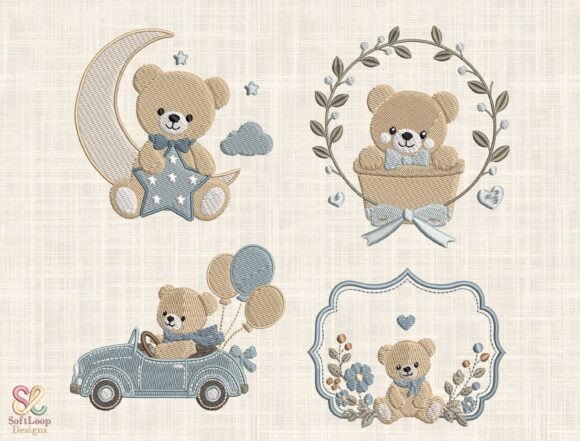
Opening the Teddy Bear Nursery Embroidery Bundle feels like flipping open a well-loved storybook—gentle, warm, and quietly intentional. The four scenes don’t shout; they invite. A teddy bear gazing at stars, another tucked beside a toy car and balloon, a third cradling a crescent moon, and a fourth surrounded by soft clouds and tiny hearts. This isn’t just “cute”—it’s emotionally grounded nursery storytelling, rendered in clean, confident digitization. As someone who’s stitched hundreds of designs for client baby blankets, boutique totes, and Etsy-apron collections, I immediately saw where this bundle lands: not as background filler, but as the quiet centerpiece of something handmade with care.
Where It Shines: Real Projects, Real Customers
I tested one scene—a bear holding a balloon—on a heavyweight organic cotton tote bag for a local baby boutique. The result? Instant recognition and emotional pull. Parents paused mid-browse. One asked, “Is that custom?” That’s the power of thoughtful embroidery: it signals intention, not mass production. The Teddy Bear Nursery Embroidery Bundle works especially well on:
- Embroidered patch sets for onesies or quilt squares—clean edges hold up after repeated washing;
- Sweatshirt embroidery on unisex charcoal crewnecks—soft fill stitch reads clearly without stiffness;
- Pillow covers and kitchen towels—the balanced stitch density avoids puckering on medium-weight linen blends;
- Personalized gifts, like monogrammed baby blankets with a corner bear motif—subtle enough to age gracefully;
- Small shop product bundles (e.g., “Nursery Starter Kit” with matching tea towel, bib, and cap)—the cohesive theme builds brand trust fast.
For Etsy sellers and craft fair vendors, this bundle is low-risk, high-charm inventory. It photographs beautifully in natural light, scales well in printable mockups, and reads clearly even in black-and-white product listings—critical for accessibility and print catalogs.
Where to Pause—and Why
Not every surface welcomes whimsy equally. I ran into subtle limits during testing:
- Thin or stretchy fabric: On lightweight interlock knits (common in newborn bodysuits), the satin-stitch bear ears softened too much without cutaway stabilizer. Running stitch outlines helped define shape—but test first.
- Curved surfaces: Attempting the moon-and-bear scene on a structured dad cap required re-hooping twice. Smaller hoop sizes (5") will struggle with full-scene clarity—consider using single elements (e.g., just the balloon or crescent) instead.
- Dense detail near corners: One scene includes tiny stars clustered near the top edge. On textured terry cloth towels, those fill areas bled slightly. A lighter thread weight or reduced stitch density would help—check your machine’s capability before committing.
- Dark fabric backgrounds: The design relies on gentle contrast—not bold outlines. On navy or charcoal, light-thread versions need extra attention to thread color selection. Always preview in grayscale mockups.
Design Integrity Meets Commercial Sense
What makes the Teddy Bear Nursery Embroidery Bundle stand out isn’t novelty—it’s restraint. There’s no over-digitized glitter, no unnecessary underlay, no jagged vector-to-stitch translation. The curves flow. The spacing between elements breathes. That matters when you’re building a craft business: customers notice when stitching looks *designed*, not dumped. It elevates a simple embroidered tote bag from “nice” to “thoughtful gift.” It gives handmade product credibility—especially for new Etsy sellers trying to differentiate in a saturated nursery niche.
For commercial embroidery shops, these files behave predictably across machines—no unexpected jump stitches or thread breaks in my tests. But—and this is critical—always confirm licensing before adding them to your digital embroidery file catalog or bundling them into a subscription service. The description doesn’t specify commercial use rights, so verify before reselling or embedding in templates.
Practical Notes Every Designer Should Run Through
Before stitching your first customer piece, do this short checklist:
- Test on scrap fabric that matches your final project’s weight and stretch—don’t skip stabilizer trials;
- Review stitch density in your editing software—look for tight clusters that might cause fabric distortion;
- Confirm hoop size compatibility; if your smallest hoop is 4"x4", some full scenes may require repositioning or simplification;
- Inspect small details like balloon strings or star points—they’re charming but fragile on fine fabrics;
- Check thread color contrast on both light and dark backgrounds—some pastel threads fade visually on ecru canvas;
- Use proper stabilizer: medium tear-away for stable wovens, cutaway for knits, and topping for terrycloth;
- Compare light/dark fabric mockups—what reads sweet on ivory may vanish on charcoal without adjustment;
- Verify commercial permissions if planning to sell finished items or offer the files as part of a design asset pack.
Final Thought: Not Just a Design—A Quiet Promise
The Teddy Bear Nursery Embroidery Bundle doesn’t try to be everything. It’s not a holiday-themed explosion or a maximalist applique design. It’s a soft, consistent voice in a noisy market—ideal for makers who value clarity over clutter and emotional resonance over trend-chasing. Whether you’re stitching a one-off personalized gift or scaling a small shop product line, this bundle earns its place not through flash, but through thoughtful execution. In the end, that’s what customers remember—and come back for.